Why Customers Cancel SaaS Subscriptions (And What to Do About Each Reason)
The 7 most common reasons SaaS subscribers cancel — backed by data from real cancellation flows — and the specific retention strategy that works for each one.
You can't fix churn if you don't understand why it's happening. Most SaaS founders look at churn as a single number — "we lost 5% this month" — without asking the more important question: why did each of those people leave?
The answer matters because the solution for each reason is completely different. A subscriber who cancels because of price needs a different response than one who cancels because they stopped using the product.
Here are the 7 most common cancel reasons we see across CancelFlow deployments, ranked by frequency — and what to do about each one.
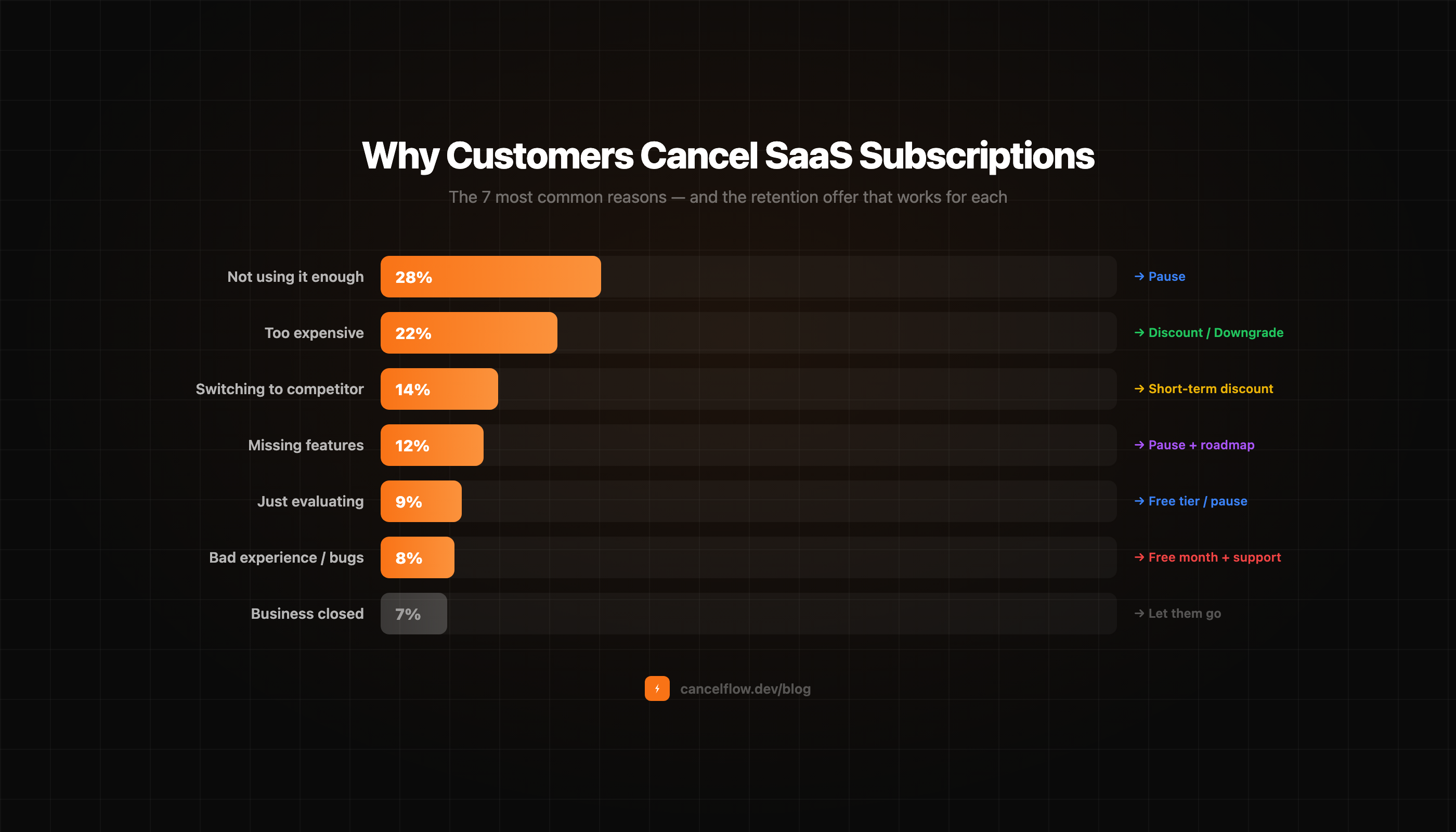
1. "I'm not using it enough" — 28% of cancellations
This is the most common reason by a wide margin. The subscriber signed up with good intentions but never built the habit. They look at their credit card statement, see your charge, and realise they haven't logged in for weeks.
What's really going on: this is almost always an onboarding or activation failure, not a product failure. The subscriber never reached the moment where your product became essential to their workflow.
What to do at the cancel moment: offer a pause. These subscribers aren't angry — they're just not engaged. A pause removes the cost pressure while keeping their account intact. When they come back in 30–60 days, they might re-engage. Across our data, 62% of subscribers who pause for "not using it enough" reactivate after the pause ends.
What to do upstream: this is the reason that's most fixable before the cancel page. Improve your onboarding sequence, add usage-based email nudges, and define your activation metric. If a user hasn't completed your core action within 7 days of signing up, reach out.
2. "Too expensive" — 22% of cancellations
Price is the second most common reason, but it's also the most misunderstood. When a subscriber says "too expensive", they're rarely saying the price is objectively high. They're saying the perceived value doesn't justify the cost.
Two types of price cancellers:
- Genuine budget constraints — their business is in a tight spot, they're cutting costs across the board, and your tool is on the chopping block. These subscribers often still see value in your product.
- Value mismatch — they don't feel they're getting enough for what they pay. This is a positioning or feature problem disguised as a price problem.
What to do at the cancel moment: offer a discount (temporary, not permanent). A 30% discount for 3 months gives budget-constrained subscribers breathing room. For value-mismatch subscribers, a downgrade to a cheaper plan is often more honest and sustainable than a discount on a plan they don't fully use.
What to do upstream: make sure your pricing page clearly communicates what each tier includes. If subscribers consistently cancel from your highest tier citing price, your tier boundaries might be wrong — consider whether features on the top tier should be on the mid tier instead.
3. "Switching to a competitor" — 14% of cancellations
This one stings, but it's also the most actionable competitive intelligence you can get. A subscriber telling you they're leaving for a competitor is giving you a free product roadmap hint.
What's really going on: they found something that does what they need better, cheaper, or more conveniently. The specific competitor they name (if your cancel survey asks) tells you exactly where to focus.
What to do at the cancel moment: this is the hardest group to save with an offer. A discount feels desperate. A pause doesn't address their reason. The best approach is a short-term discount combined with a genuine message: "We're actively working on [the thing the competitor does better]. Stay for 3 months at 40% off and see if we close the gap." This only works if it's true.
What to do upstream: track which competitors are named most frequently. If one competitor keeps appearing, do a deep analysis of their product and figure out what they're doing that you're not. Use this data in product planning.
4. "Missing features I need" — 12% of cancellations
The subscriber likes your product in principle but it doesn't do something they need. This is different from a competitor switch — they may not have found an alternative yet. They've just decided your tool can't do what they need.
What to do at the cancel moment: offer a pause and ask which specific feature they need. If it's already on your roadmap, tell them — "We're shipping [feature] in the next 6 weeks. Want to pause your subscription until then?" This has a surprisingly high acceptance rate because it's specific and credible.
What to do upstream: every "missing feature" cancellation should feed into your feature request tracker. If the same feature gets mentioned 10+ times in cancel surveys, it should be prioritised. Your cancel flow is one of the most honest sources of product feedback you have.
5. "Just testing / evaluating" — 9% of cancellations
These subscribers signed up to kick the tyres and were never planning to stay long-term. They wanted to see if the product was a fit, decided it wasn't (or decided it was but the timing isn't right), and now they're leaving.
What to do at the cancel moment: offer a downgrade to a free tier if you have one, or a pause. The goal is to keep them in your ecosystem with zero cost so that when the timing is right, they come back. Don't offer a discount — it signals that you think they should pay, which they've already decided against.
What to do upstream: make your free trial long enough and frictionless enough that evaluators can reach an "aha moment" before the trial ends. If 9% of your cancellations are evaluators, your trial might be too short or your onboarding might not be showing enough value quickly enough.
6. "Bad experience / bugs" — 8% of cancellations
Something broke, or the experience was frustrating enough that the subscriber gave up. This is the most urgent cancel reason because it means there's something actively wrong with your product.
What to do at the cancel moment: apologise and offer a free month (not a discount — a full credit). These subscribers are frustrated, and a percentage-off discount feels tone-deaf. A free month says "we hear you, we're sorry, give us another chance on us." Pair it with a direct line to support: "Reply to this email and our CTO will personally look into it."
What to do upstream: treat every "bad experience" cancellation as a P1 bug report. If you see this percentage climbing, something is wrong with your product quality and it needs immediate attention. Even 8% is high — world-class SaaS products keep this under 3%.
7. "Business closed / no longer needed" — 7% of cancellations
The subscriber's business shut down, pivoted, or no longer needs your category of tool. There's nothing wrong with your product — their situation changed.
What to do at the cancel moment: make the cancellation smooth and painless. Don't show retention offers to someone whose business just closed — it's tone-deaf. The best thing you can do is leave a good impression: "Sorry to hear that. Your data will be available for 30 days if you need to export anything. We hope to see you again in the future."
What to do upstream: nothing. This is unavoidable churn. The only action item is to make sure you're correctly categorising it so it doesn't inflate your "fixable churn" metrics.
The pattern: match the offer to the reason
The biggest mistake SaaS companies make with churn prevention is showing the same offer to everyone. A blanket 20% discount shown to every cancelling subscriber will miss most of these segments entirely.
| Cancel reason | Best offer | Save rate |
|---|---|---|
| Not using it enough | Pause (30–60 days) | 45–55% |
| Too expensive | Discount or downgrade | 30–40% |
| Switching to competitor | Short-term discount | 10–15% |
| Missing features | Pause + roadmap update | 25–35% |
| Just evaluating | Free tier / pause | 20–30% |
| Bad experience | Free month + support | 35–45% |
| Business closed | None — let them go | 0% |
The compound effect is significant. A cancel flow that asks why someone is leaving and then shows them the right offer based on their answer will save 30–40% of cancelling subscribers. A cancel flow that shows everyone the same offer will save 10–15%.
How to implement this
You need two things: a cancel reason survey (even 4–5 options is enough) and conditional offer logic that maps each reason to the right retention offer.
You can build this yourself — it takes a few days of Stripe API work, webhook handling, and frontend logic. Or you can use CancelFlow, which does all of this out of the box with one script tag. The cancel reason survey, conditional offers, and Stripe actions (pause, discount, downgrade) are all handled automatically.
Either way, the key insight is the same: stop treating churn as one problem. It's seven different problems, each with a different solution. Fix them individually and your overall churn rate drops dramatically.
Stop losing subscribers today
One script tag. One function call. A live cancellation flow in under 10 minutes.
Start free trial →