How to Calculate and Reduce SaaS Churn Rates
Learn how to calculate customer churn rate, revenue churn rate, and net churn — then reduce them with proven strategies that recover MRR immediately.
Churn is the silent killer of SaaS businesses. You can grow 10% month-over-month, but if you're losing 8% of subscribers each month, you're running on a treadmill. Understanding exactly how churn works — how to measure it, what the numbers mean, and what actually reduces it — is the difference between a SaaS that compounds and one that plateaus.
This guide covers every churn formula you need, what the benchmarks look like, and the specific interventions that move the number. No vague "improve your product" advice — concrete strategies ranked by impact and speed of implementation.
The 4 churn formulas every SaaS needs
There isn't one churn rate — there are several, and they each tell you something different. You need at least the first two. The other two become important as you scale.
1. Customer churn rate (logo churn)
The most straightforward measure: what percentage of your subscribers cancelled this period?
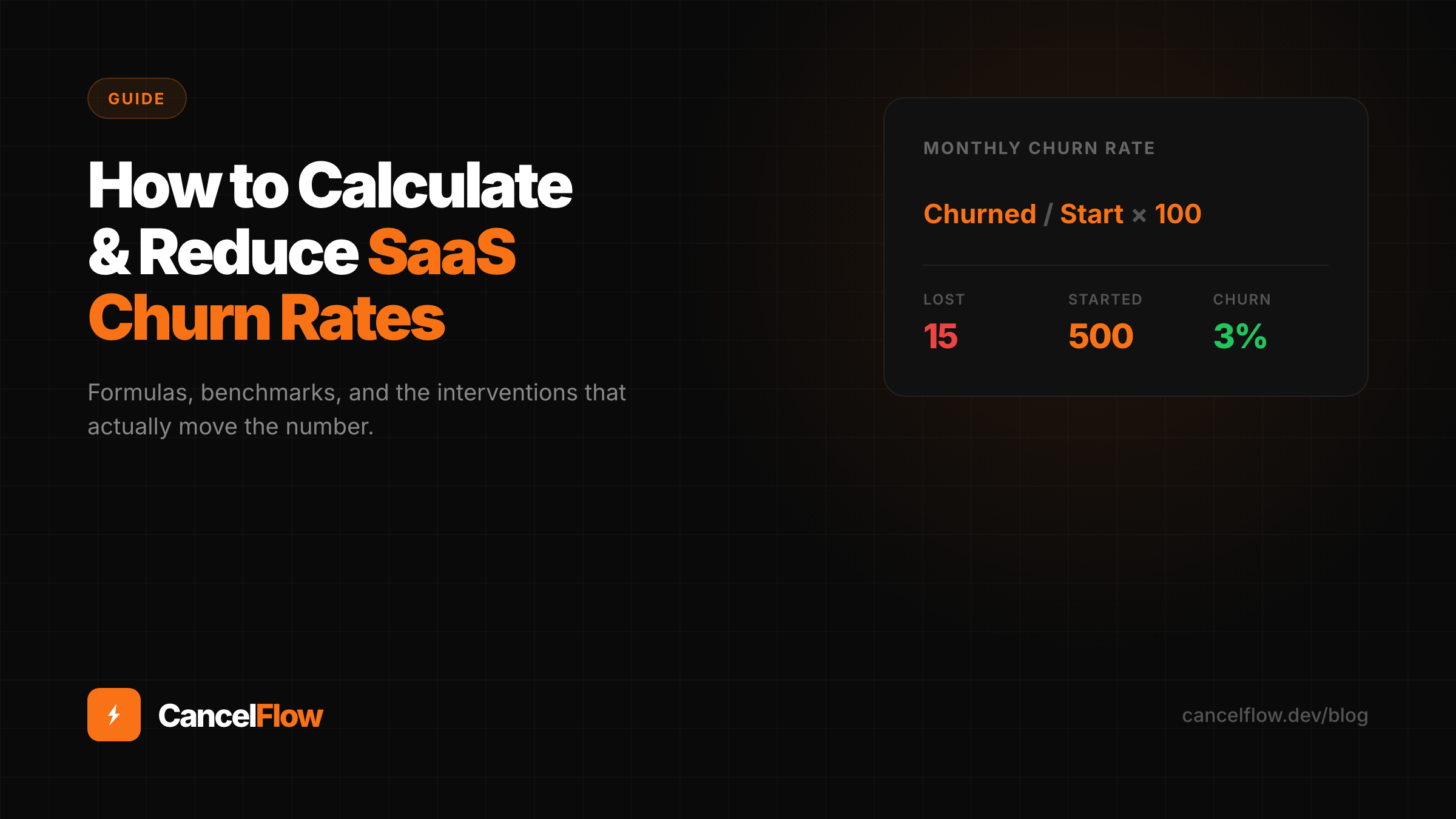
Customer Churn Rate = (Subscribers lost during period / Subscribers at start of period) × 100
Example: You start the month with 500 subscribers. 15 cancel. Your monthly customer churn rate is 3.0%.
This is the number most founders track, and it's a good starting point. But it treats every subscriber equally — losing a $9/month subscriber counts the same as losing a $299/month subscriber. That's why you also need revenue churn.
2. Revenue churn rate (MRR churn)
How much recurring revenue did you lose to cancellations and downgrades?
MRR Churn Rate = (MRR lost to cancellations + downgrades) / MRR at start of period × 100
Example: You start the month with $50,000 MRR. You lose $1,200 to cancellations and $300 to downgrades. Your MRR churn rate is 3.0%.
Revenue churn is often more actionable than customer churn because it reveals where the money is actually going. If your customer churn is 3% but your revenue churn is 5%, your higher-paying subscribers are leaving at a higher rate — that's a critical signal. For a deeper breakdown, see our guide on MRR churn rate.
3. Net revenue churn
This accounts for expansion revenue — upgrades, add-ons, and seat increases from your existing subscriber base.
Net Revenue Churn = (MRR lost − MRR gained from expansion) / MRR at start of period × 100
Example: You lose $1,500 in MRR but gain $2,000 from upgrades. Your net revenue churn is −1.0% (negative churn). Your existing customers are growing your revenue even without new sign-ups.
Negative net revenue churn is the holy grail of SaaS. It means your business will grow even if you stop acquiring new customers entirely. The best SaaS companies operate at −5% to −15% annual net revenue churn. For more context, see net revenue retention benchmarks.
4. Annual churn rate
Don't just multiply your monthly churn by 12 — that's wrong because churn compounds. Use this:
Annual Churn Rate = 1 − (1 − monthly churn rate)^12
Example: A 3% monthly churn rate compounds to 30.6% annual churn, not 36%. Still bad — it means you're replacing nearly a third of your customer base every year just to stay flat.
SaaS churn rate benchmarks
Knowing your churn rate is useless without context. Here's what good looks like across segments:
| Segment | Monthly churn | Annual churn | Notes |
|---|---|---|---|
| Consumer / Prosumer | 5–10% | 46–72% | High volume, low switching cost |
| SMB (under $100/mo) | 3–7% | 31–58% | Most indie SaaS lives here |
| Mid-market ($100–$1k/mo) | 1–3% | 11–31% | Higher switching costs help |
| Enterprise ($1k+/mo) | 0.5–1% | 6–11% | Annual contracts reduce churn |
If you're above the top of your range, churn reduction should be your #1 priority — it'll have a bigger impact on growth than any acquisition channel. For a more detailed breakdown, see our SaaS churn rate benchmarks guide.
Why churn matters more than you think
The compounding effect of churn is unintuitive. Here's a concrete example:
Two SaaS companies both add 50 new subscribers per month at $29/month. Company A has 3% monthly churn. Company B has 6% monthly churn. After 24 months:
- Company A: 1,023 subscribers, $29,667 MRR
- Company B: 694 subscribers, $20,126 MRR
Same acquisition. A 3-percentage-point difference in churn creates a $9,500 MRR gap in just two years. Over five years, that gap becomes a canyon. This is why a 1% reduction in churn compounds into more revenue than a 1% increase in acquisition.
How to reduce SaaS churn: ranked by impact
Not all churn reduction strategies are equal. Here they are, ranked by speed of impact and typical ROI:
1. Add a cancellation flow with retention offers
Impact: High | Speed: Immediate | Effort: Low
When a subscriber clicks "cancel", most SaaS products show a confirmation dialog and let them leave. That's leaving money on the table. A well-designed cancellation flow asks why they're leaving and responds with a relevant retention offer:
- "Not using it right now" → offer a subscription pause
- "Too expensive" → offer a discount or downgrade
- "Missing a feature" → share your roadmap or suggest a workaround
- "Switching to a competitor" → ask what they're switching to (this data is gold)
This approach typically saves 25–40% of at-risk subscribers. That's an immediate, measurable reduction in churn with no product changes required. With CancelFlow, you can add a complete retention flow to any Stripe subscription product in under 5 minutes — one script tag and one function call.
For a deep dive on designing these flows, see Stripe cancellation flow best practices and pause vs discount vs downgrade.
2. Fix involuntary churn
Impact: High | Speed: Fast | Effort: Low–Medium
Involuntary churn — cancellations caused by failed payments, not subscriber intent — accounts for 20–40% of all SaaS churn. Most of it is preventable.
- Enable Stripe Smart Retries (automatic, no code needed)
- Send pre-dunning emails when cards are about to expire
- Follow up on failed payments with a helpful message, not a threatening one
- Consider using a tool like Stripe's revenue recovery features
Recovering even half of your involuntary churn can reduce total churn by 10–20%. See our full guide on Stripe dunning and involuntary churn.
3. Convert monthly subscribers to annual plans
Impact: Medium–High | Speed: Medium | Effort: Low
Annual subscribers churn at 2–4× lower rates than monthly subscribers. The commitment itself creates retention, and the upfront payment reduces the decision points where a subscriber might leave.
Offer a meaningful discount (15–20%) for annual billing. Surface the annual option during onboarding and in your upgrade flows. Some SaaS products also offer annual-only pricing for higher tiers.
4. Improve onboarding and activation
Impact: High | Speed: Slow | Effort: High
Subscribers who don't reach your product's "aha moment" during their first week are significantly more likely to churn. Map the actions your highest-LTV subscribers take in their first 7 days and make those actions as frictionless as possible.
- Reduce time-to-value by removing unnecessary setup steps
- Send targeted nudges to users who haven't completed key actions
- Offer a guided onboarding call for engaged trials who aren't converting
This is the highest-leverage long-term investment, but it takes time to implement and measure. Start with the cancellation flow first, then use the cancel reason data it collects to inform your onboarding improvements.
5. Collect and act on cancel reasons
Impact: Medium | Speed: Ongoing | Effort: Low
Every cancellation is data. A cancellation survey built into your cancellation flow gives you a categorised stream of reasons why people leave. Review these weekly and look for patterns:
- If 40%+ cite "missing features" → that's a product gap to close
- If "too expensive" dominates → revisit your pricing or the way you communicate value
- If cancellations spike at month 3 → your onboarding isn't delivering enough long-term value
This data should drive your product roadmap and prioritisation. It's the closest thing you have to your churned subscribers telling you exactly what would have kept them.
6. Win back churned subscribers
Impact: Low–Medium | Speed: Medium | Effort: Low
Cancelled subscribers aren't gone forever. A targeted win-back sequence sent 30, 60, and 90 days after cancellation — with an offer relevant to their cancel reason — can bring back 5–15% of churned subscribers.
This won't change your monthly churn rate, but it recovers MRR from subscribers you've already lost. Think of it as a bonus on top of your prevention efforts.
Common mistakes when measuring churn
A few pitfalls that lead to misleading churn numbers:
- Using end-of-period subscriber count as the denominator — always use start-of-period. Using end-of-period artificially inflates the rate.
- Annualising by multiplying monthly × 12 — churn compounds. Use the (1 − monthly)^12 formula instead.
- Ignoring trial-to-paid drop-off — if you count trial users as subscribers, your churn rate will look artificially high when trials expire.
- Mixing voluntary and involuntary churn — they have completely different causes and fixes. Track them separately.
- Not segmenting — a blended churn rate hides the real story. Break it down by plan, price tier, acquisition channel, and subscriber age.
The bottom line
Churn reduction compounds. Every percentage point you shave off your monthly churn rate translates into significantly more MRR over 12, 24, 36 months. The maths always favours retention over acquisition — it's just less visible, which is why most founders under-invest in it.
Start by calculating your actual churn rates using the formulas above. Compare them to your segment benchmarks. If you're above the range, the highest-ROI first step is adding a cancellation flow — it takes minutes, produces results immediately, and gives you the cancel reason data you need to prioritise everything else.
Frequently asked questions
How do you calculate SaaS churn rate?+
Divide the number of subscribers who cancelled during a period by the number of subscribers at the start of that period, then multiply by 100. For example, if you started the month with 500 subscribers and 15 cancelled, your monthly churn rate is 3%.
What is a good SaaS churn rate?+
It depends on your segment. SMB SaaS should aim for under 5% monthly, mid-market under 2%, and enterprise under 1%. If you sell annual contracts, target under 10% annual churn. Any monthly churn rate above 7% is a serious problem regardless of segment.
What is the difference between customer churn and revenue churn?+
Customer churn measures the percentage of subscribers who cancel. Revenue churn (MRR churn) measures the percentage of recurring revenue lost. They can diverge significantly — losing 10 subscribers on your cheapest plan has a different revenue impact than losing 10 enterprise accounts.
What is net revenue churn?+
Net revenue churn accounts for expansion revenue (upgrades, add-ons) alongside lost revenue from cancellations and downgrades. If you lose $2,000 in MRR to churn but gain $2,500 from upgrades, your net revenue churn is negative — meaning your existing customer base is growing even without new sign-ups.
How can I reduce SaaS churn quickly?+
The fastest intervention is adding a cancellation flow with retention offers. When a subscriber tries to cancel, showing a relevant offer (pause, discount, or downgrade) typically saves 25–40% of at-risk subscribers. This can be implemented in under 5 minutes with CancelFlow and produces immediate MRR recovery.
What causes high SaaS churn?+
The most common causes are poor onboarding (users never reach the "aha moment"), pricing misalignment, missing features that competitors offer, and involuntary churn from failed payments. Collecting cancel reasons through a cancellation survey is the fastest way to identify which driver is dominant for your product.
Stop losing subscribers today
One script tag. One function call. A live cancellation flow in under 10 minutes.
Start free trial →